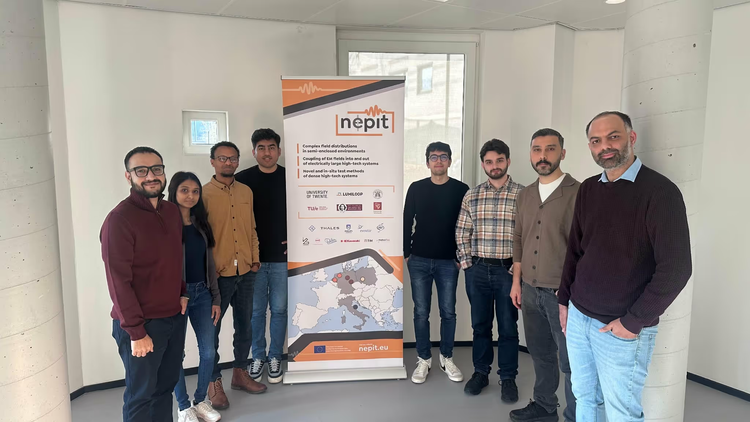
One Year into NEPIT – What It Really Feels Like
It’s been one year since I moved from Greece to the Netherlands to start my PhD within the Network for Evaluation of Propagation and Interference (NEPIT) project.
When I think back to the first weeks, I mostly remember two things: excitement and confusion.
Excitement because I was starting something big — a European doctoral network, new country, new research environment. Confusion because suddenly I was surrounded by discussions about reverberation chambers, statistical field behavior… and I was trying to absorb everything at once.
Finding My Footing
Coming from an electrical engineering background helped, of course. But NEPIT operates in a very specific space. There’s a lot of depth, and a lot of detail. At the beginning, even the terminology felt heavy.
I spent a big part of the first year reading. Papers, reports, standards, more papers. Some days it felt productive. Other days it felt like I was just realizing how much I didn’t know.
But slowly, something changed.
Conversations started making more sense. I could follow discussions without mentally translating every second sentence. I stopped just trying to understand existing work and started questioning it. That shift — from “What is going on?” to “Why is it done this way?” — was probably the biggest milestone of my first year.
Being Part of a Doctoral Network
One thing that makes NEPIT different is that it’s not just a local PhD. It’s part of the Marie Skłodowska-Curie Actions (MSCA) framework, which means you’re connected to other doctoral candidates across Europe working on related topics.
The network-wide meetings were honestly one of the highlights of the year. It’s reassuring to realize that everyone else is also navigating their own technical challenges and uncertainties. Different projects, different focuses — but very similar struggles.
It makes the process feel less isolated.
If I had to summarize this year in one sentence, it would be: research is much less linear than I expected. You don’t just move forward in a straight line.
You circle around ideas. You revisit assumptions. You spend days on something that doesn’t work, and then one small insight changes your direction completely.
There were moments of doubt. Moments where progress felt slow. But looking back, the progress is obvious — just not in the way I imagined at the start.
Beyond the Technical Side
Moving countries also changes you in ways you don’t anticipate. You build new routines. You adapt to a different work culture. You become more independent by necessity.
The first year was not just about equations and simulations. It was about learning how to operate in a new environment — academically and personally.
And that part matters just as much.
Looking Ahead
Finishing the first year feels like crossing an invisible line. The exploration phase is slowly turning into focused work. The “trying to understand everything” phase is becoming “working on something specific.”
There’s still a lot ahead. But I feel more grounded now — in the project, in the research, and in myself as a doctoral candidate.
If the first year taught me anything, it’s that growth in research is subtle. You don’t always notice it day to day. But after twelve months, you can clearly see it.
And that’s a good place to be.