

Secondments as a bridge between academia and industry
As a part of my MSCA funded PhD within the NEPIT project, secondments play a crucial role in shaping both my research and my professional development. They are not just short research visits, they are carefully designed opportunities to step outside the comfort zone of my home university and experience different research cultures and expectations. During my PhD journey, I will complete two secondments, each lasting two months. The first one has already been completed at Metratec GmbH, and the second is planned at Eindhoven University of Technology (TU/e) in the Netherlands.
First secondment: Industrial experience at Metratec
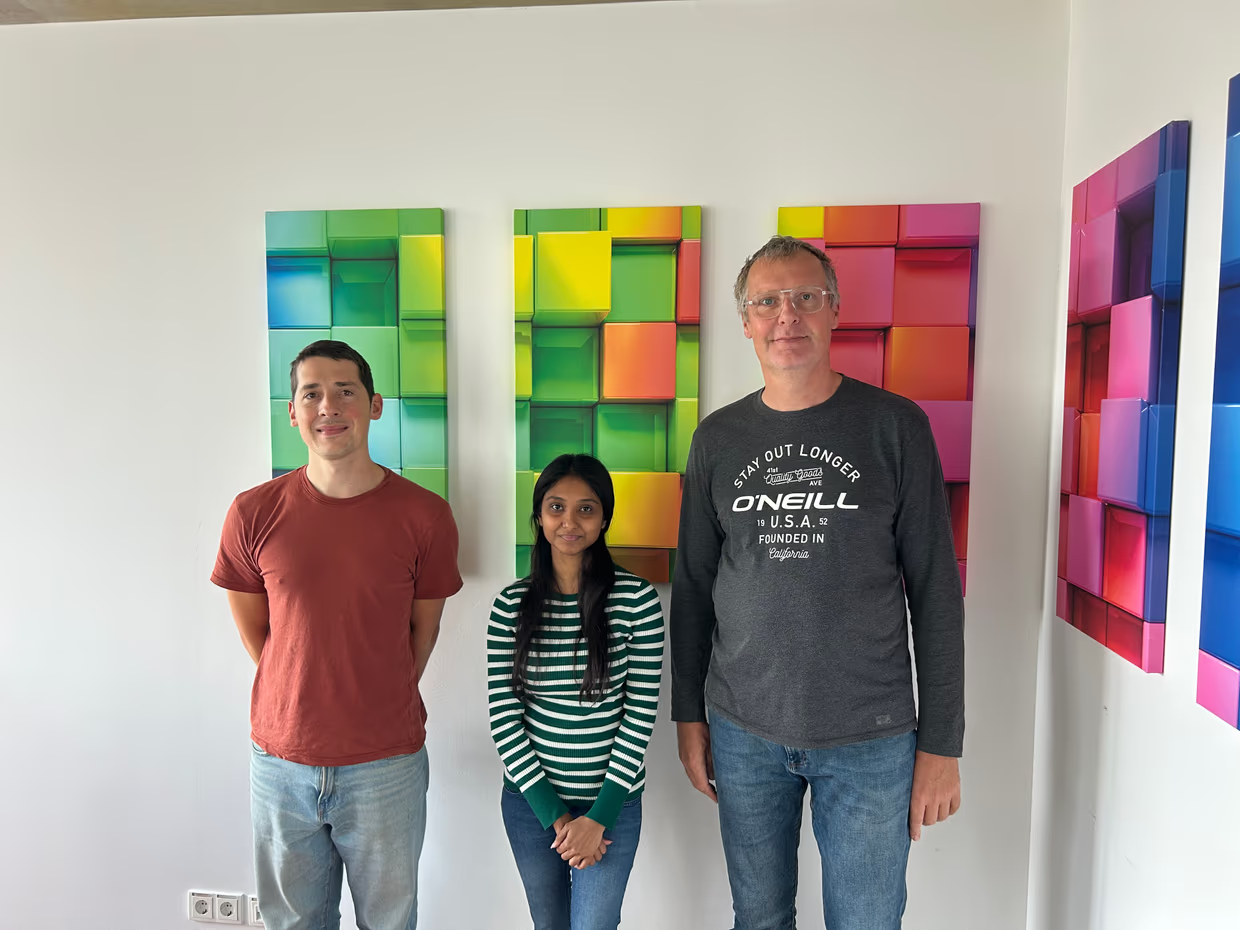
My first secondment took place at Metratec GmbH in Magdeburg. One of the biggest advantages of this secondment was its proximity to my home university. Being in the same city made the transition smooth and stress free. There was no need to relocate, no accommodation challenges and no major disruption to my daily routine. This made it as ideal starting point for my first secondment experience.
At Metratec my work strongly experimental oriented. I was involved in Gigahertz Transverse Electromagnetic (GTEM) cell validation. It required hands on experimental work. I had the opportunity to work with professional measurement equipment such as spectrum analyzers, vector network analyzers (VNA) and electric field probes which played a key role in the validation activities. Unlike purely academic research, the industrial environment emphasizes efficiency, reproducibility and real-world applicability. In addition, the work required careful consideration of relevant industrial standards, ensuring that the measurements and validation procedures met established compliance requirements.
This experience gave me valuable insight into how research outcomes are translated into industrial products and services. I leaned how experimental setups are optimized for reliability, how measurements are validated under industrial standards, and how teamwork functions in a nonacademic setting. Beyond technical skills I also gained a deeper understanding of industrial workflows, communication styles and expectations.
Most importantly, I truly enjoyed my time at Metratec. The experience was both educational and motivating. It also helped me appreciate how industrial secondments can enrich a PhD by grounding theoretical knowledge in real world applications.
Second secondment: Academic exchange at Eindhoven University of Technology
The second secondment, which I will begin in near future, will take place at Eindhoven University of Technology in the Netherlands. Unlike the first secondment, this one requires international relocation and a temporary stay away from my home university and from ma family.
One of the main challenges of this secondment is accommodation. The Netherlands, especially university cities like Eindhoven faces a well-known housing shortage, and the cost of living in relatively high. Finding a suitable accommodation for a short stay can be challenging. However, this challenge is manageable with early planning. From this experience, one key lesson stands out even before the secondment begins, preparation is everything. Starting early, organizing documents in advance, and being proactive are essential to avoid last minute difficulties.
On a personal level, this secondment also means staying away from my child for two months. This is not easy. However, I strongly believe that this experience is worth it. As a PhD researcher, such opportunities are rare and valuable and they contribute significantly to both personal growth and scientific development.
From a research perspective, I am particularly excited about this secondment. The work at TU/e will focus on reverberation chamber based experimental research, which aligns closely with myPhD topic while offering a different experimental environment and expertise. Compared to the industrial focus of my first secondment, this one will emphasize academic collaboration, advanced measurement techniques, and knowledge exchange within a university setting. I am looking forward to learning new methodologies, working with experienced researchers, and gaining fresh perspectives on my research problem.
Comparing two secondments
Looking at both secondments together, they represent two different but equally important dimensions of my PhD journey. The first secondment at Metratec offered industrial exposure, practical problem solving, and hands on validation work in a familiar environment. The second secondment at Eindhoven University represents academic mobility, international collaboration, and advanced experimental research.
While the first secondment was easier to start due to its proximity and familiarity, the second one pushes me further out of my comfort zone. This contrast is exactly what makes the MSCA-NEPIT secondment framework so valuable. It encourages researchers to adapt, grow, and gain a holistic view of their field.
Final thoughts
Secondments are more than just a requirement in an MSCA funded PhD. They help bridge the gap between academia and industry, theory and practice, comfort and challenge. Despite the professional or personal difficulties, I see these secondments as an investment in my future as a researcher.
As I move forward with my second secondment, I carry the lessons learned from the first: stay open, stay prepared, and make the most of every opportunity. I am confident that, together, these experiences will significantly enrich my PhD journey within the NEPIT project.